

Trusted by sales leaders at NVIDIA, OpenAI, Red Hat, HPE, Zscaler, and Rubrik - and 100,000+ sellers daily.




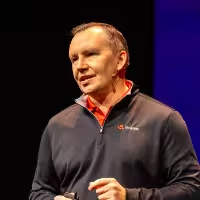





























Backstory gives sellers and managers a clear view of pipeline with actionable insights. It changed how we plan and execute - our forecast finally feels like something we own.


See the full picture before the quarter gets away from you.
- See total pipeline coverage by rep, segment, and stage - know where you're thin before it shows up in the forecast.
- Know which reps are carrying the most risk and where coverage needs to be built right now.
- "Where do I focus my team?" Prioritize based on what's actually happening in each deal.
A strong quarter doesn't start with the forecast call. It starts with knowing what you're working with.
See risk before it becomes a miss.
- Know which deals have real gaps: missing executive sponsor, no business case, a competitor that just showed up
- See which deals are actually qualified - based on what's happening in emails, meetings, and calls.
- Drill into any deal. See engagement history, what's missing, and what to do next.
When you see the problem early, you still have time to fix it.
Get straight answers. Act on them.
- "Is this deal actually committed?" See if the engagement matches the call.
- "Which deals close this quarter?" Know based on stakeholder coverage and buying signals.
- "Where do I focus my team?" Prioritize based on what's actually happening in each deal.
From uncertainty to confident action - before it's too late to change the outcome.
Know what moved. Own the call.
- See exactly what changed: what slipped, what closed-lost, what decreased in value - broken down automatically
- See which deals drove each movement, who owns them, and what shifted in the last 30 days.
- Walk into the board meeting with facts, not a narrative
Know the answer before anyone asks the question.
Get the full Backstory on your pipeline. Take the tour.
See what Backstory can do for you.
Questions & Answers
Legacy forecasting tools predict risk based on CRM data - which is whatever reps remembered to log. Backstory surfaces risk based on what's actually happening: engagement dropping, a champion going dark, a competitor showing up in conversation. The difference is the data underneath the signal.
Backstory captures every email, meeting, call, and chat automatically and matches it to the right opportunity. Risk surfaces when:
- Engagement drops or a key stakeholder goes dark
- A deal is single-threaded with no executive involvement
- A competitor shows up in conversation
- The economic buyer has low buying power or low win rates
- Activity patterns diverge from deals that historically close in your business
You see the problem while there's still time to fix it - not after the deal dies.
- Which deals are at risk of slipping?
- Which deals have stalled and why?
- What changed in this deal since last week?
- Is my commit defensible?
- Which commits are backed by actual activity?
It changes them. Instead of spending the first 40 minutes of a forecast call figuring out what happened, you walk in knowing which deals moved, why the number changed, and what needs attention. The meeting becomes a decision about what to do, not a discovery exercise.
Backstory captures activity directly from email, calendar, calls, and chat - not from what reps entered in the CRM. The risk flags reflect what's actually happening in deals, not what someone remembered to log.
Yes. Backstory surfaces your top risk categories ranked by revenue impact - engagement gaps, missing stakeholders, stalled progression - so you see where to focus across the full pipeline in one view, not deal by deal.
That's exactly what Backstory is built to catch. When rep-reported status and actual engagement data diverge, Backstory surfaces it. A deal marked commit with no buyer engagement in 21 days shows up as a problem before it becomes a surprise.
Yes. Backstory captures activity across your full revenue motion - including partner and co-sell engagements - and matches it to the right accounts and opportunities. You can see how partners are influencing deals: which contacts they're engaged with, where they're adding momentum, and where gaps exist. You get the complete picture of every deal, not just what your direct team touched.